
Changing My Mind (unlocked)
about Gouge Sharpening...and more

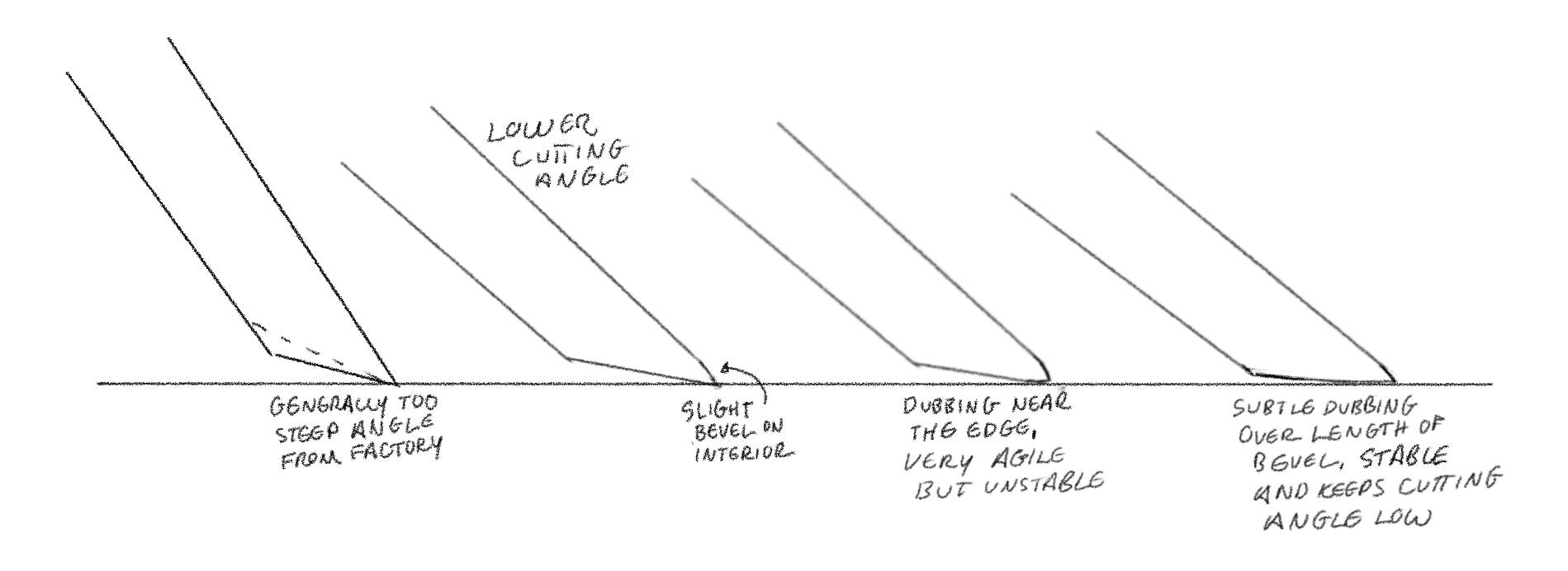
I can’t tell you how many lessons I learned from Dave Fisher this week. Among other things, I was very curious about his technique for gouge sharpening. I felt vindicated by his grinding method. He grinds freehands with the gouge perpendicular to the wheel like I do. He also lays the angle much further back than it arrives from the factory and toughens it up by honing a slight curve on the interior of the bevel. But that was just the beginning of the lesson.
I’ve always wondered how Dave gets the gouge marks in his bowls to be so clean and even. Yes, years of practice have something to do with it, but so does the shape of the gouge. A sharp edge is only useful if the geometry of the edge is correct. Tools for carving require a slight curvature, or “dubbing” to perform. Without the dubbing, the tool will just dig into the surface and be nearly impossible to control. This curve is subtle. If it gets too extreme, the angle of the tool in use becomes higher and getting smooth, long, consistent cuts can be difficult. I’ve always focused my attention, and dubbing, close to the cutting edge, where the strop has the most impact. But Dave does it differently, and it makes perfect sense when you see how he uses the tool, and his results. Dave works to keep the bevel perfectly flat throughout the grinding and honing process, allowing just a slight curve to come in during the honing. Most importantly, this curve happens over the entire length of the bevel.
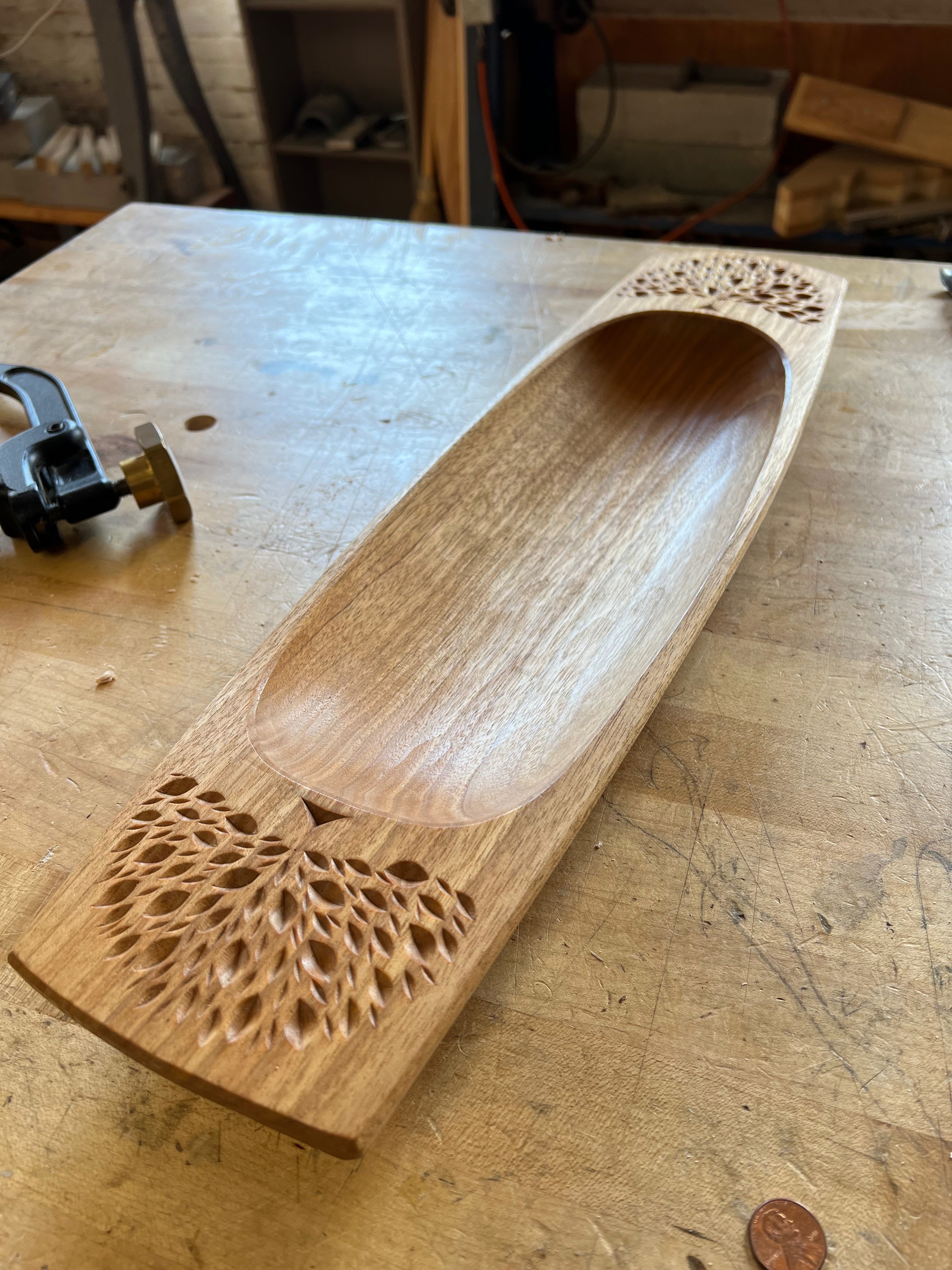
By doing so, it’s more natural to have the cutting edge stay in the cut during his long even cuts. One of my favorite things about Dave’s work is the tool marks are bold and decisive. No matter how long ago they were made, his pieces always look perfectly fresh, as though he just finished them and stepped out of the room. His ability to land on a shape and surface at the same time are akin to a gymnast “sticking the landing”.
Here’s the difference between the gouge shapes.
Over the week together, Dave and I had many discussions about craft, technique and teaching. Watching Dave in class, I thought about how impactful it is to be in the presence of someone with such deep knowledge. He didn’t just show a bunch of techniques, like you might find steps in an instruction manual. Being with him in person, I got a better feel for the stuff that happens inbetween the tool cuts. I saw the focus and intent that makes his carving so alive.
I heard an interesting story on a favorite podcast You Are Not So Smart. On his deathbed, James Madison’s niece noticed him change his expression. She asked if he was alright? With his last words, he replied “Nothing more than a change of mind, my dear. I always talk better lying down.” I’ve always taken this phrase for granted “change my mind”. I’ve thought of it as a decision between choices e.g. chocolate or vanilla. I think it’s easy to see a woodworking class as a series of techniques to learn, but watching Dave teach highlighted how it can offer a fundamental shift in the your own mind. I think differently now. I hope you get a chance to work with him in the future. His October class is full, but I’m hoping to convince him to come back next year.