
The V Notch

The V notch is a simple detail that unlocks lots of others. I learned to make this detail while turning double bobbin and bamboo turnings. It adds a pleasing shadow line that breaks up long parts into interesting sections, punctuating a rhythm of spacing and proportion. Most importantly though, making this little detail requires movement that leads to complex shapes like beads and coves, namely shifting the path and bearing surface of the tool away from the surface of the wood and towards the center.
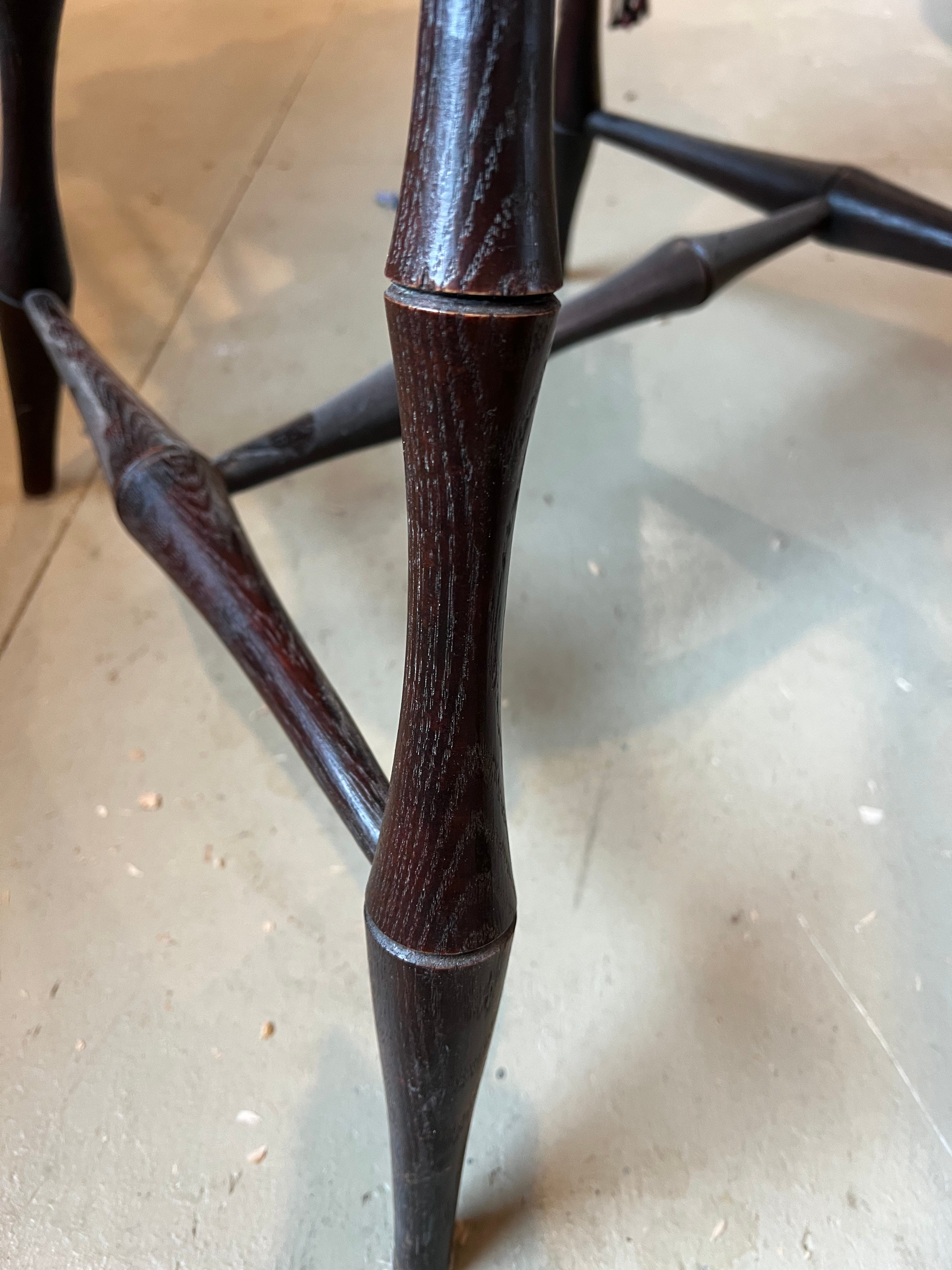
So far in this series of posts, I’ve detailed cuts that follow the surface of a work piece. Cutting cylinders, tapers and even curves is basically the same behavior. This is what I call “on axis”, which means you are pressing the bevel of the tool against a spinning part and then adjusting the tool until the edge starts cutting while following the shape down the length of the part. With “off axis” cuts, you are plunging towards the center of the part, using the exposed endgrain as the bearing surface. This is a very different cut and I believe deserves it’s own category. Why? Just about every complex shape requires you to move fluidly between on and off axis cuts. When you make a bead, the position of the tool starts as though you were just smoothing as surface, but it ends by plunging toward the center of the work piece in an off axis cut. A cove is the opposite, you start with a plunging cut and then straighten out at the bottom of the cove into a cut that follows the axis.
You might think a parting tool cut is “off axis” because you are cutting directly into the piece, but it still follows the action of “on axis” cutting, namely, making contact with bevel first and adjusting the angle until it starts cutting. Yes, you do end up plunging towards the center, but the shavings are always peeling away from the surface in the same direction as a planing cut. I know I’m droning on about this, but it’s because I think it’s a huge mental shift to see these cuts as different, and once you do, you can address them differently, even though they often must be made while making a single shape. It was a huge “A-ha” moment for me and I think it might help you advance to complex shapes with control and consistency.
The V notch is my favorite entry point to “off axis” cutting and once you learn it, you will be more comfortable with the off axis motions needed to make other shapes. I taught myself how to make V notch, which means I spent lots of time playing around to figure out why it worked sometimes and where the catches and problems came from. One of the biggest hurdles I faced is that the tool must start cutting without the bevel making contact with the work piece, which means misalignment between the tool position and motion will cause a catch. This sounds like there is only one way to success, but that isn’t the case. Once you understand the relationship between the position of the tool and motion as it contacts the piece, you can make anything work, it just makes a deeper or more shallow V notch. It’s when the two aren’t relating well that you run into trouble.
I’m teaching a class this week, but I hope to make a video showing the basics of “off axis” cutting and V notches once I get the snow cleared.
Wow Peter! I like this way of thinking about the cutting action and orientation to the wood. I think it will be very helpful and am looking forward to the progression to come.