
Vibration Unplugged

In the most recent video in the skew series, I finally showed using the skew with the lathe actually turned on. When I was setting up to film, I grabbed the closest piece of wood to chuck up. It was a long, thin piece of ash, and during the demonstration it vibrated. I was focused on the movement and tool position, so I didn’t really care, but folks started asking me about dealing with the vibration. So, let’s turn off the tool and talk about it. The next video I shoot will show techniques for using the skew to conquer vibration. The skew is the one tool that can slay just about any vibration, but not on it’s own. First, we gotta turn off the lathe again to get to the bottom of what causes vibration.
Vibration shows up in the actual wood, both in the motion of the piece and the surface left by the cuts. The piece will rumble and make noise, sometimes even visibly become a little blurry as it spins. One the surface there is a telltale spiral pattern that can take many forms depending on how extreme the problem is. The issue is caused by a combination of resistance at the cutting edge and lack of support for the piece. This causes the wood to deflect and whip as you turn. Once vibration starts, it’s hard to get rid of because you’ve flexed the wood and now it’s limbered and maybe even a bit misshapen. The other issue is that the surface of the piece, once textured, acts like a bumpy road that most tools can’t smooth, but the skew usually can.
But let’s start with the lathe. I use relatively light lathes, so I usually add weight to the base to make them more stable. Some folks build the stand as a box and fill it with sand, I use solid cinder blocks. I find cross bracing helps a lot. My favorite lathe has a classic metal stand, and while it’s cool, it doesn’t dampen vibration as much as my shop made wood ones that have a sheet of ply screwed to the back. It’s also helpful to have the lathe near the wall or over a support beam and if you can, fastened to the wall. Basically anything you can do to add mass and stability. In the video, I pulled my lathe away from the wall which always makes the vibration worse. A fun way to actually see the stability of your lathe is to place a cup of water on the lathe bed and turn the tool on. Note the ripples on the surface, then add some weight to the base and notice the difference in the ripples. Obviously you want a calmer surface…and experience.
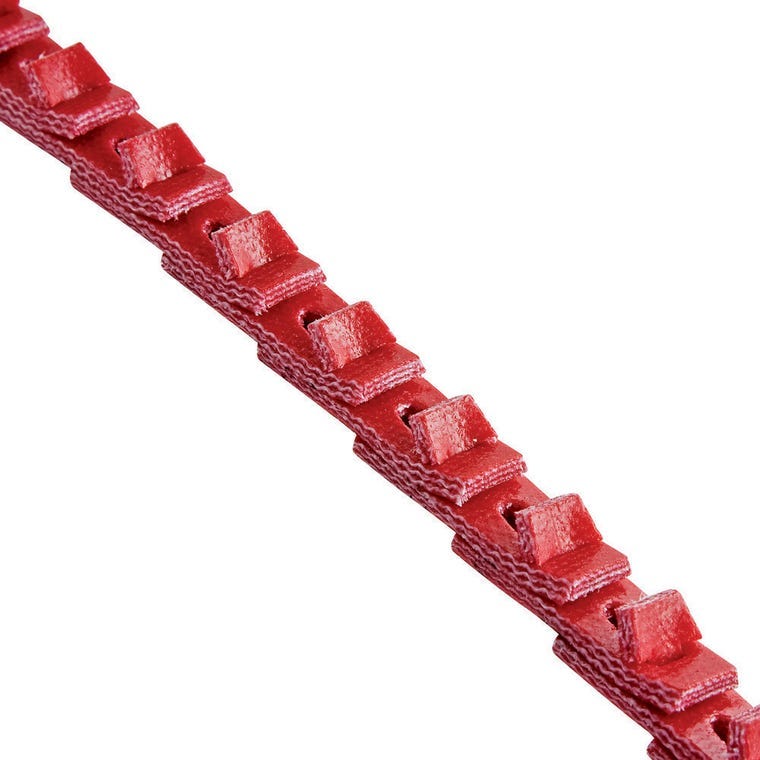
Besides thinking about the mass and stability, I also use link belts on all my lathes. I became sold on these a long time ago, not just because you can size them easily, but they really do reduce vibration. You can get them at your favorite woodworking catalogue. They don’t form a “memory” when left sitting on the tool, so there is never a bump coming from the belt that transfers to the work piece.
Sharp tools make a huge difference, sorry, but it’s true. The grind matters as well. Basically, if the shavings meet too much resistance, either from a dull tool or having to break abruptly against the bevel of the skew, you can get vibration. Everything you do with the tool that resists the rotation can be an issue. This is another reason I prefer a relatively low angle on my skew, it allows the shavings to form without too much deflection. The long bevel also makes lots of contact with the wood to steady the work piece. To much pressure on the bevel can be a problem and cause deflection, but contact can stability the part.
The position of the tool can factor as well. If the edge of skew is presented more parallel to the work piece (with the handle perpendicular), it will be taking a larger cut and force the shavings to break abruptly which increases resistance and vibration. Skewing the edge both takes a lighter cut and lets the shaving shear at an angle so they curl away more easily.
Then there’s the wood. It probably goes without saying, but long skinny pieces will vibrate more than short fat ones. And on long skinny pieces, you will get more vibration near the center of the part and less as you approach the head and tail stock. I do many turnings that must be long and skinny, so just avoiding thin parts isn’t an option. Steady rests can be handy, but they are also cumbersome and only on my longest parts do I find I need them. In the video below, you can see me using a steady rest on a rocking chair post. Placing the steady rest in the middle effectively cuts the length into two short section. Here is a video I post a while back about the use of the steady rest and a post with the details for making one.
